

A Practical Guide to Automation Part Life Cycles
In this article:
- Why Manufacturers Retire Parts (Typically)
- Key Phases in an Automation Part Lifecycle
- Determining the Status of Your Components
- Staying Ahead of Obsolescence Challenges
- How CJS Automation Can Help
If you spend enough time around industrial systems, you begin to recognise that no component remains available forever. Every automation part follows a path from introduction through to eventual withdrawal, and understanding that path is essential for anyone responsible for maintenance or procurement.
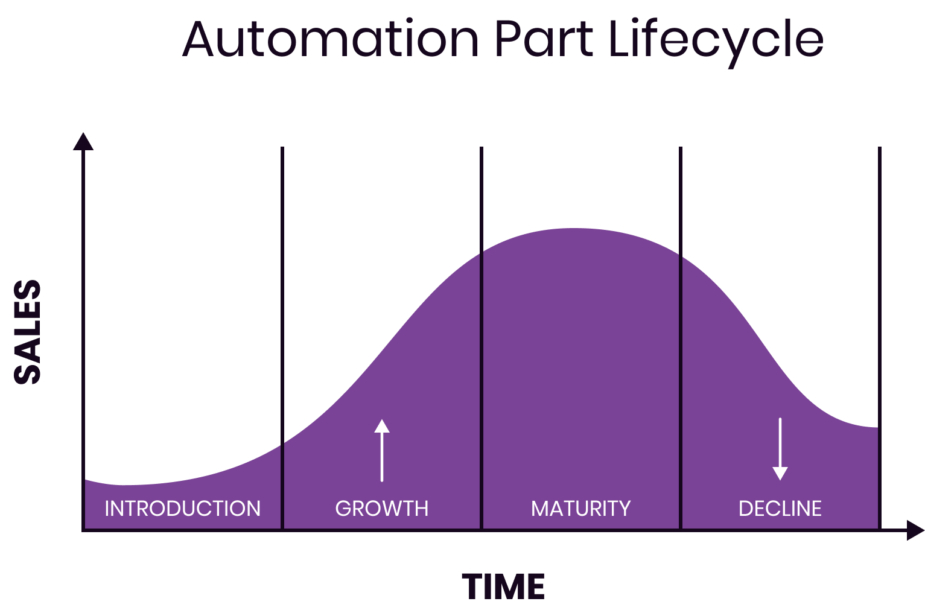
A part life cycle refers to the progression a component goes through during its time in the market. It begins when a manufacturer releases a product and continues until that product is no longer supported or supplied. Each stage affects availability, pricing, and the ease of sourcing a replacement.
While at CJS Automation, I have seen how often this is overlooked. Many businesses only consider lifecycle status when a failure occurs, which is rarely the ideal moment. A more considered approach allows you to anticipate change rather than react to it.
When you understand where your components sit within their lifecycle, decisions become clearer. You can plan stock levels, assess alternatives, and avoid unnecessary disruption. It is not about overcomplicating procurement. It is about staying one step ahead.
Why Manufacturers Retire Parts (Typically)
Manufacturers do not withdraw parts without reason. Each decision is typically driven by a combination of technical progress, supply considerations, and long-term product strategy.
One of the most common factors is technological advancement. As newer systems are developed, older components no longer align with current performance standards or integration requirements. Supporting both generations becomes inefficient, so focus shifts toward updated designs.
Component availability also plays a role. If key materials or subcomponents become difficult to source, continuing production becomes less practical. This is something I have seen affect otherwise reliable parts that simply could not be sustained due to supply chain changes.
There is also the matter of efficiency. Maintaining legacy products requires engineering support, documentation, and manufacturing resources. Over time, this diverts attention from newer innovations that better meet current industry demands.
Market demand cannot be ignored either. When usage declines, production volumes follow. At that point, continuing to manufacture a part serves little purpose.
Understanding these factors helps explain why lifecycle changes occur. It also reinforces the importance of monitoring your equipment and preparing for what comes next.
Key Phases in an Automation Part Lifecycle
Automation components move through several recognised stages. Although terminology can vary slightly between manufacturers, the underlying meaning remains broadly consistent.
- Active
- The part is fully supported and widely available. Manufacturers continue production, and sourcing is straightforward.
- Mature, Phase-out or Classic
- Availability remains, though focus may shift toward newer models. Lead times can become less predictable.
- Last Time to Buy, Limited, Cancellation or “End of Life (In Stock)”
- A critical stage where the manufacturer signals that production will soon cease. This is often the final opportunity to secure stock directly.
- Discontinued
- Production has stopped. Remaining units may still be available through distribution channels, but supply is no longer guaranteed.
- Repair Only
- The part is no longer available, but existing units can still be repaired or refurbished through specialist suppliers.
- Obsolete or End of Life
- The part is no longer available through standard routes. Sourcing typically requires specialist suppliers or consideration of alternatives.
Recognising these phases is not simply academic. Each one signals a shift in how you should approach purchasing and planning.
What this might look like (dependent on manufacturer):

Determining the Status of Your Components
Identifying where a part sits in its lifecycle is a task that should never be left to guesswork. There are several reliable ways to establish its current status, and each provides a different layer of clarity.
Start with the manufacturer’s website. Entering the exact part code will often reveal whether the component is active, approaching discontinuation, or already phased out. This is usually the most direct source of information, though it is not always as clear as one might hope.
That is where speaking to a trusted supplier becomes essential. At CJS Automation, we regularly assist customers who are unsure how to interpret lifecycle data. A listing might suggest limited availability, yet there may still be viable stock in circulation. Understanding the difference can prevent unnecessary concern or, just as importantly, avoid complacency.
If questions remain, the next step is to review compatible parts. Looking at alternatives and their lifecycle status can provide a clearer direction. It also helps ensure that any replacement you choose is not nearing the same phase as the original component.
I remember working with a maintenance manager who assumed a part was still active because it appeared in a catalogue. A quick check revealed it had entered its final purchasing window. Acting quickly allowed them to secure stock before availability tightened. That small step made a significant difference to their operations.
Staying Ahead of Obsolescence Challenges
Awareness of lifecycle stages changes how you manage automation systems. It encourages forward planning rather than reactive decision-making, which is where many difficulties begin.
By checking manufacturer data, consulting knowledgeable suppliers, and reviewing alternative options, you gain a clearer picture of your position. This approach reduces uncertainty and supports more confident purchasing decisions.
When parts reach discontinued or obsolete status, sourcing them requires experience and access to the right networks. This is where a specialist partner becomes invaluable. At CJS Automation, we guide customers through the process of locating hard-to-find components and, where necessary, identifying suitable replacements.
Preparation remains the strongest advantage. When you understand the lifecycle of your equipment, you are far better equipped to maintain continuity and avoid disruption.
How CJS Automation Can Help
At CJS Automation, we support you in this process by supplying automation parts across their life cycle, helping your organisation keep critical equipment productive. As a specialist parts retailer, we focus on fast, reliable sourcing and ship efficiently worldwide. We can help you:
- Interpret life‑cycle signals and prioritise at‑risk components.
- Source current, legacy, and replacement units, including options to support phased migrations.
- Align purchases with firmware and configuration needs to reduce commissioning time.
- Build a practical, cost‑effective spares strategy for your installed base.

 GB
GB  US
US  DE
DE  DK
DK  ES
ES  FI
FI  FR
FR  IT
IT  NL
NL  NO
NO  PT
PT  SE
SE